2025-10-29
What Is a Boring Head? Types, Components, and How It Works
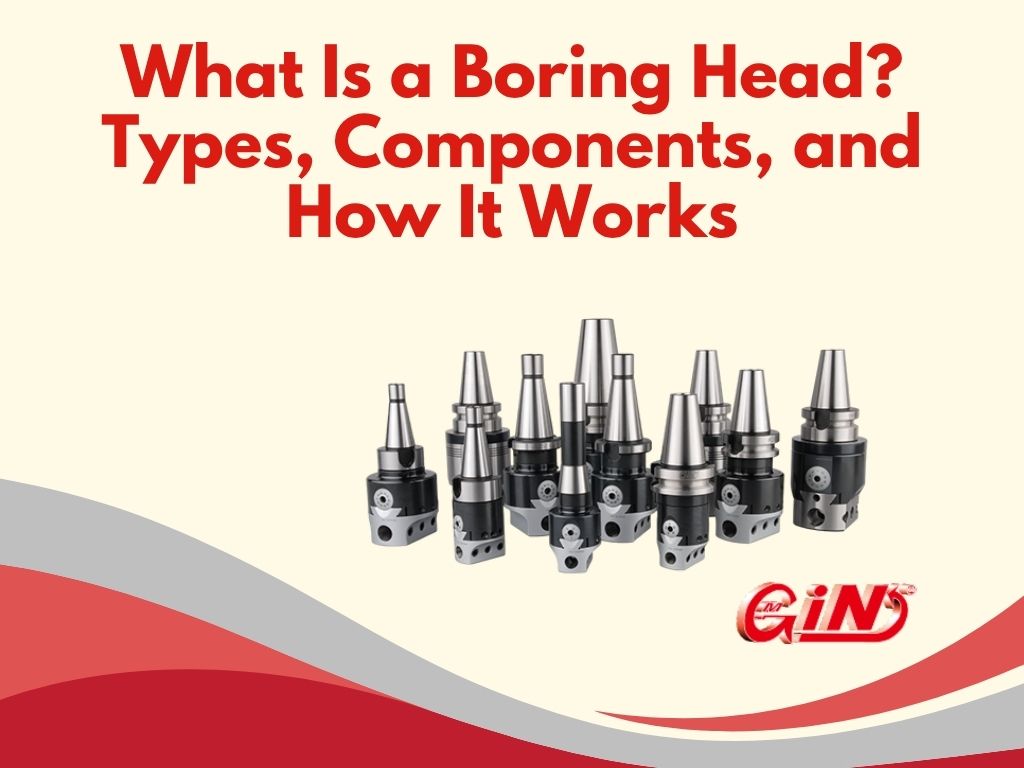
In precision machining, accuracy and surface finish are everything. When you need to enlarge or finish an existing hole with tight tolerances and smooth surfaces, a boring head becomes an essential tool. Unlike drilling, which removes material to create a rough hole, boring refines that hole to a precise diameter and alignment—making it a crucial operation in high-precision CNC machining.
This article will explain what a boring head is, how it works, its main components, and the different types available for various machining tasks.
What Is a Boring Head?
A boring head is a precision tool used to enlarge, straighten, or finish pre-drilled or cast holes. It is typically mounted on a milling machine, machining center, or boring mill and is used to achieve superior dimensional accuracy and surface quality.
The boring head holds a single-point cutting tool—commonly referred to as a boring bar—that can be finely adjusted to achieve the desired bore diameter. This fine control allows machinists to achieve tolerances within microns, making it indispensable in industries such as aerospace, automotive, and mold manufacturing.
Key Components of a Boring Head
Understanding the structure of a boring head helps explain how it achieves such precision:
-
Body: The main structure that houses the adjustment mechanism and tool holder, typically made from hardened steel for rigidity.
-
Adjustment Slide: Allows the boring bar to move radially for diameter changes. The precision of this slide directly impacts hole accuracy.
-
Adjustment Screw or Micrometer Dial: Enables fine diameter control. High-quality models can achieve adjustments as fine as 0.01 mm or even 0.001 mm.
-
Tool Holder / Boring Bar Slot: Secures the boring bar to ensure consistent cutting performance.
-
Shank: Connects the boring head to the spindle, available in CAT, BT, HSK, or R8 types for compatibility with different machines.
Types of Boring Heads
Different applications require different boring head types:
-
Rough Boring Head: For heavy-duty material removal and large-diameter holes.
-
Fine Boring Head: For high-precision finishing where tight tolerances are needed.
-
Digital Boring Head: Features digital readouts for micron-level accuracy.
-
Modular Boring System: Allows interchangeable adapters and extensions for various diameters and depths.
Gin Tech Precision Boring Heads
At Gin Tech, we design and manufacture precision boring heads that deliver outstanding accuracy, stability, and performance for CNC machining applications. Our boring heads feature:
-
High-precision micrometer adjustment – Each boring head provides fine and repeatable diameter control with clear micrometer graduations, allowing accurate size correction during finishing operations.
-
Hardened alloy-steel body for rigidity – The body is heat-treated and precision-ground to ensure long-term stability and minimize deflection.
-
Well-balanced structure for smooth machining – Optimized balance reduces vibration and chatter, improving surface finish and tool life.
-
Interchangeable shanks and boring bars – Compatible with multiple spindle types and boring bar sizes for versatile use on various machining centers.
These features make Gin Tech’s boring heads ideal for precise, repeatable, and efficient hole finishing in demanding production environments.
Applications
Boring heads are widely used across industries requiring precise hole finishing:
-
Aerospace: Bearing housings and hydraulic components.
-
Automotive: Cylinder bores, valve seats, and engine blocks.
-
Mold & Die: Precision cavities and alignment bores.
-
Heavy Machinery: Shafts, gears, and hydraulic sleeves.
Their combination of rigidity and fine adjustment makes them indispensable for both manual and CNC machining.
FAQ: Common Questions About Boring Heads
Q1: What is the difference between a boring head and a boring bar?
A boring head is the adjustable tool holder that controls the cutting diameter, while the boring bar is the actual cutting tool mounted inside the head.
Q2: How precise can a boring head be?
High-quality fine boring heads can achieve adjustment accuracy down to 0.001 mm, making them suitable for ultra-fine finishing and tight-tolerance bores.
Q3: Can boring heads be used on CNC machines?
Yes. Modern boring heads—including digital and modular types—are designed for CNC machining centers, offering repeatable precision and programmable tool offsets.
Q4: How do I prevent chatter during boring?
Ensure proper balance, minimize tool overhang, use sharp inserts, and maintain a rigid setup. Gin Tech’s well-balanced design helps minimize vibration at high speeds.
Q5: What industries benefit most from boring heads?
Boring heads are essential in automotive, aerospace, die & mold, and precision manufacturing, where accuracy, concentricity, and surface finish are critical.
Conclusion
A boring head is more than just a hole-finishing tool—it’s a precision system that transforms rough holes into perfectly machined bores. By combining micrometer-level adjustment, high rigidity, and balance, it plays a vital role in achieving accuracy and repeatability across modern CNC machining applications.
☛ At Gin Tech, we are committed to developing high-precision boring heads and workholding accessories that improve machining performance and reduce downtime. Contact our team today to discover how our boring solutions can help you achieve superior accuracy and productivity.