2026-02-13
Magnetic Chuck vs Vise: Which Workholding Method Is Better for Your Setup?
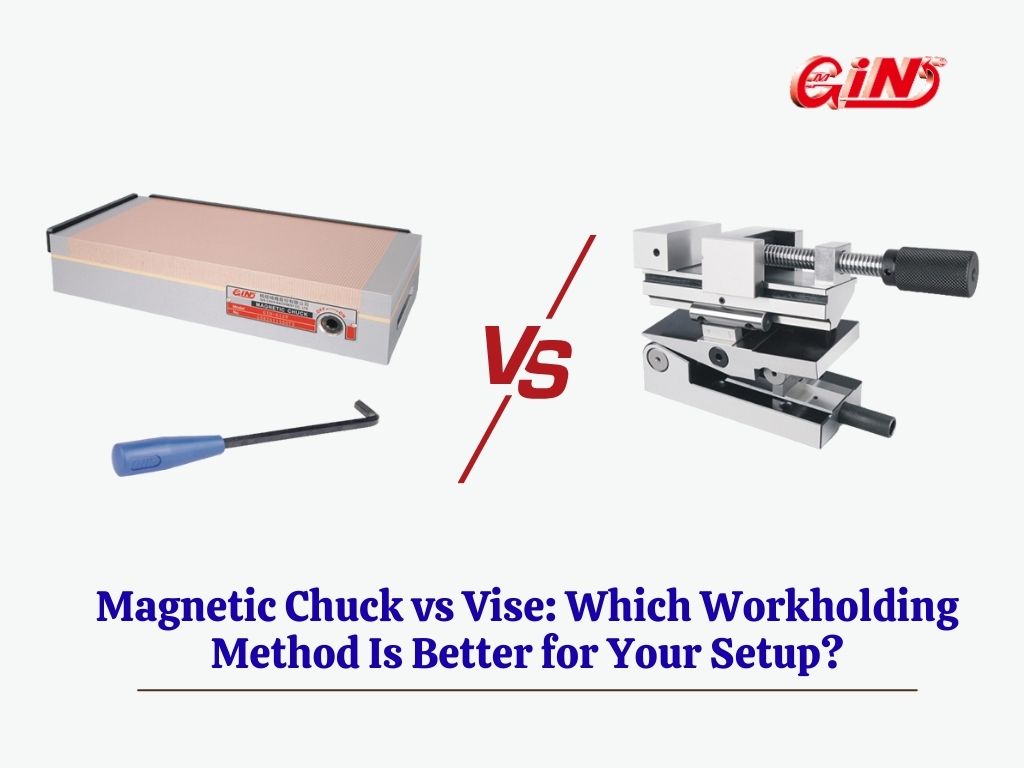
Selecting the right workholding method is one of the most important decisions in precision machining and grinding. Even with a high-end machine tool and quality cutting tools, poor workholding can lead to vibration, dimensional errors, and inconsistent surface finish. Two of the most widely used solutions are the magnetic chuck and the vise. Each offers unique advantages depending on the machining process, workpiece shape, and accuracy requirements.
This guide compares magnetic chucks and vises in practical terms, helping machinists and engineers choose the best workholding method for their specific setup.
What Is a Magnetic Chuck?
A magnetic chuck is a workholding device that uses magnetic force to secure ferrous workpieces. It is most commonly used on surface grinding machines, but can also be found in EDM and light milling applications.
Magnetic chucks are generally divided into:
-
Permanent magnetic chucks
-
Electromagnetic chucks
-
Electro-permanent magnetic chucks
Instead of mechanical clamping, the chuck holds the workpiece evenly across its contact surface. This creates uniform holding force without localized jaw pressure.
Magnetic chucks are especially effective for:
-
Thin plates
-
Flat workpieces
-
Large surface-area parts
-
Precision surface grinding operations
What Is a Vise in Machining Workholding?
A vise is a mechanical clamping device that holds a workpiece between jaws using screw, hydraulic, or pneumatic force. There are several types used in precision machining, including:
-
Grinding vise
-
Modular vise systems
Unlike a magnetic chuck, a vise grips the part from the sides or ends, creating directional clamping force. This makes vises more suitable for heavier cutting and multi-face machining.
Key Difference #1: Clamping Method
The most fundamental difference is how each system holds the part.
Magnetic chuck:
-
Uses distributed magnetic force
-
No jaw marks or side pressure
-
Even holding across the base surface
Vise:
-
Uses mechanical jaw clamping
-
High directional holding force
-
Better resistance to cutting loads
If your process involves heavy cutting forces, a vise—especially a milling vise or self-centering vise—usually provides more secure resistance against tool pressure.
Key Difference #2: Best Use by Machining Process
Different processes favor different workholding styles.
Magnetic chuck is best for:
-
Surface grinding
-
Light finishing cuts
-
Thin or wide plates
-
Parts that must remain flat
-
Quick placement and removal
Vise is best for:
-
Milling operations
-
Drilling and tapping
-
Multi-face machining
-
EDM setups (with tool maker vise or grinding vise)
-
4-axis and 5-axis machining
In many precision shops, magnetic chucks and vises are used together rather than as substitutes.
Key Difference #3: Workpiece Shape and Thickness
Workpiece geometry strongly affects the choice.
Magnetic chucks perform best when:
-
The part has a large flat contact area
-
Material is ferromagnetic
-
Thickness is sufficient to hold magnetic flux
Vise systems perform better when:
-
The part is tall or narrow
-
Side clamping is required
-
The shape is irregular
-
The material is non-magnetic
For example, a tool maker vise used as a grinding vise is often preferred when grinding small blocks or precision components that are not ideal for direct magnetic holding.
Key Difference #4: Setup Speed vs Holding Strength
Magnetic chucks are extremely fast to use:
-
Place the part
-
Activate magnet
-
Start machining
There is no jaw adjustment, alignment, or torque control required. This makes them ideal for repetitive flat-part grinding.
Vise setups take longer but provide:
-
Higher clamping force
-
Adjustable jaw positioning
-
Better security under heavy cutting
For multi-part CNC milling, a self-centering vise can significantly reduce setup time while maintaining mechanical clamping strength.
Key Difference #5: Accuracy and Distortion Control
Magnetic chucks apply holding force evenly across the surface, which helps reduce localized distortion—especially important for thin parts.
However, magnetic holding force is limited compared to mechanical clamping. Under aggressive cutting, parts may shift.
Precision vises—such as tool maker vises and self-centering vises—are designed to balance:
-
Clamping force
-
Jaw parallelism
-
Minimal lift and tilt
-
Repeatable positioning
This makes them more suitable for precision machining with measurable cutting loads.
Combining Magnetic Chucks and Precision Vises
In advanced setups, machinists often combine both systems.
Common examples include:
-
Mounting a tool maker vise on a magnetic chuck for precision grinding
-
Using a grinding vise for small precision parts on a magnetic table
-
Pre-machining in a milling vise, then finish-grinding on a magnetic chuck
This hybrid approach provides both flexibility and precision.
FAQ: Magnetic Chuck vs Vise
Q1: Can a magnetic chuck replace a vise?
For surface grinding of flat ferrous parts, yes. For milling or heavy cutting, a vise is usually required.
Q2: Do magnetic chucks work on all metals?
No. They only work on ferromagnetic materials such as steel and iron.
Q3: Is a grinding vise better than a magnetic chuck?
Not universally. A grinding vise is better for small precision blocks and side clamping. A magnetic chuck is better for flat plate grinding.
Q4: Are self-centering vises suitable for grinding setups?
They are more commonly used in CNC machining, but can be used in precision setups where symmetric clamping is required.
Conclusion
Both magnetic chucks and vises are essential workholding tools, but they serve different purposes. Magnetic chucks excel in flat surface grinding and fast setup, while vises provide stronger, directional clamping for machining operations.
Choosing between a magnetic chuck and a vise should be based on your machining process, workpiece geometry, and cutting load—not just convenience.
At Gin Tech, we provide a full range of precision workholding solutions—including milling vises, tool maker vises, grinding vises, self-centering vises, and magnetic chucks—to support accurate and stable workholding across diverse machining and grinding applications. Whether your setup requires mechanical clamping strength or magnetic surface holding, our team can help you select the most suitable solution for your process and production goals.
If you’d like to evaluate the best workholding solution for your application, feel free to contact our team.