2026-01-23
Milling Vise vs. Self-Centering Vise: Which Is Better for Multi-Part Production?
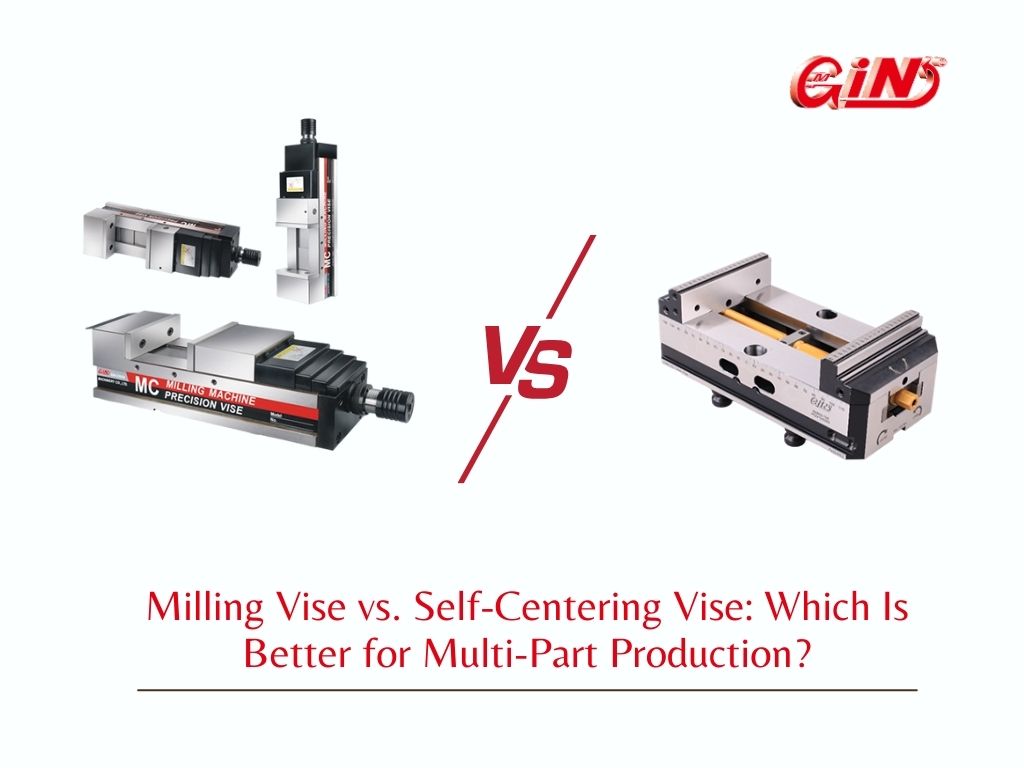
In modern CNC machining, productivity is no longer defined only by cutting speed. Setup time, positioning repeatability, and clamping consistency play an equally important role—especially in multi-part production. Choosing the right workholding system can significantly impact throughput, accuracy, and operator workload.
Among the most widely used solutions are the milling vise and the self-centering vise. While both are essential in precision machining, their designs and strengths serve different production needs. This article compares these two workholding systems and helps manufacturers determine which option best fits multi-part CNC production.
The Role of a Milling Vise in CNC Machining
A milling vise is the most common workholding device found on vertical and horizontal machining centers. It provides strong, direct clamping force to hold a workpiece securely during cutting operations.
Typical advantages of a CNC milling vise include:
- High clamping force for heavy cutting
- Strong rigidity for rough and semi-finish machining
- Simple and familiar operation
- Wide size range for different part dimensions
Because of these characteristics, milling vises remain the primary choice for general machining tasks and heavy-duty material removal.
However, when production shifts toward multi-part or symmetric machining, traditional milling vises can introduce inefficiencies. Each part must be individually aligned, clamped, and verified, increasing setup time and the risk of positioning variation between parts.
What Is a Self-Centering Vise?
A self-centering vise is designed to clamp a workpiece symmetrically from both sides, automatically positioning the part at the center of the vise. This eliminates manual alignment and ensures consistent centering every time.
Self-centering vises are widely used in:
- Multi-part batch production
- 4-axis and 5-axis machining
- Symmetrical component machining
- Automated loading systems
Because both jaws move simultaneously, self-centering vises deliver excellent repeatability and reduce operator dependency—key benefits in modern CNC production environments.
Key Differences in Multi-Part Production
1. Setup Time and Part Changeover
With a standard milling vise, operators must manually position each workpiece against fixed jaws or parallels. In multi-part production, this repetitive alignment adds significant setup time.
A self-centering vise automatically positions each part in the same centered location, dramatically reducing:
- Manual alignment steps
- Setup verification time
- Operator fatigue
This results in faster part changeover and improved overall machine utilization.
2. Repeatability and Positioning Accuracy
In batch machining, even small positioning differences between parts can lead to tolerance inconsistencies.
- Milling vise: Positioning accuracy depends on operator skill and external stops.
- Self-centering vise: Center position is mechanically fixed, ensuring consistent part location every cycle.
For multi-part production where tight tolerances are required, self-centering vises offer a clear advantage in repeatable accuracy.
3. Suitability for Multi-Axis Machining
Traditional milling vises can obstruct tool access in 4-axis and 5-axis machining due to their higher profile and fixed jaw structure.
Self-centering vises typically feature:
- Compact, low-profile bodies
- Symmetrical jaw movement
- Better tool clearance
This allows more machining operations to be completed in a single setup—reducing repositioning and cumulative error.
4. Clamping Force and Cutting Style
For heavy rough-cutting operations:
- A heavy-duty milling vise provides maximum clamping force and rigidity.
- A self-centering vise focuses on precision clamping and balanced force distribution.
In multi-part production involving medium to finishing cuts, self-centering vises maintain sufficient holding strength while improving consistency and surface quality.
5. Automation Compatibility
As more manufacturers introduce robotic loading and lights-out machining, workholding must support automated workflows.
Self-centering vises are naturally suited for automation because:
- No manual alignment is required
- Part insertion is repeatable
- Jaw synchronization simplifies robot handling
Milling vises can be automated as well, but typically require additional positioning systems or sensors.
Gin Tech Milling and Self-Centering Vise Solutions
At Gin Tech, we design both high-precision milling vises and advanced self-centering vises to support diverse CNC production requirements—from heavy cutting to high-accuracy multi-part machining and automation.
Our milling vises provide:
- High rigidity for heavy and general CNC milling operations
- Precision-ground jaw and base surfaces for stable positioning
- Strong clamping force for consistent machining accuracy
Our PQV self-centering vises are engineered for precision, efficiency, and automation-ready production environments. Key features include:
- High-precision machining design for exceptional accuracy and repeatable positioning
- Quick jaw adjustment mechanism to reduce setup and changeover time
- Strong and balanced clamping force to prevent slippage and minimize workpiece deformation
- Automation-ready structure compatible with robotic loading and unmanned production
- Zero-point system compatibility supporting 96/52 grid patterns, EROWA and System 3R quick-change systems
By selecting the right vise type—whether a heavy-duty milling vise or a high-precision self-centering vise—manufacturers can significantly improve machining consistency, setup efficiency, and productivity across multi-part and automated production scenarios.
FAQ: Milling Vise vs. Self-Centering Vise
Q1: Can a self-centering vise replace a standard milling vise?
In many precision and multi-part production tasks, yes. However, heavy rough-cut milling may still benefit from a dedicated heavy-duty milling vise.
Q2: Which vise offers better repeatability?
Self-centering vises provide superior repeatable positioning because parts are automatically centered without manual adjustment.
Q3: Are self-centering vises suitable for 5-axis machining?
Yes. Their compact, symmetrical design improves tool accessibility in multi-axis machining.
Q4: Do milling vises cost less than self-centering vises?
Generally yes, but self-centering vises often reduce setup labor costs and increase throughput, improving overall ROI.
Conclusion
Both milling vises and self-centering vises play important roles in CNC machining. For general and heavy cutting, a traditional milling vise remains a reliable choice. For multi-part production, high repeatability, and automation-ready workflows, a self-centering vise offers clear efficiency advantages.
At Gin Tech, we provide precision workholding solutions designed to meet the evolving needs of modern CNC manufacturing. Choosing the right vise is not just about holding a part—it’s about unlocking higher productivity and consistent accuracy across every machining cycle.
If you’d like to evaluate the best vise solution for your application, feel free to contact our team.