2026-07-29
How Punch Formers Improve Accuracy and Repeatability in Tool Grinding
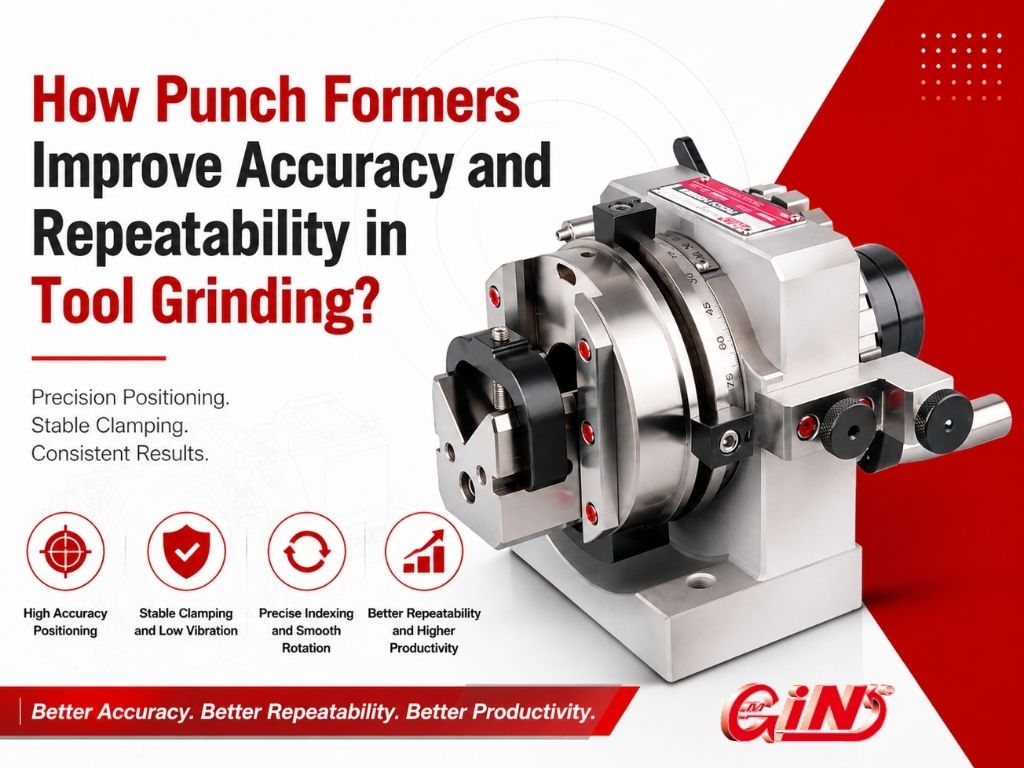
In precision manufacturing, even the smallest variation in tool geometry can affect machining quality, surface finish, and product consistency. Whether producing punches, cutting tools, or precision components, maintaining accurate grinding results is essential for achieving tight tolerances and reliable production.
One accessory that plays a critical role in precision grinding is the punch former. Although compact in size, a punch former significantly improves positioning accuracy, rotational control, and repeatability during tool grinding. By enabling precise indexing and stable workholding, it helps manufacturers produce consistent results while reducing setup time and operator error.
This article explores how a punch former improves accuracy and repeatability in tool grinding, why it is widely used in tool rooms and mold shops, and what features to look for when selecting one.
What Is a Punch Former?
A punch former is a precision grinding accessory designed to hold and rotate cylindrical workpieces during grinding operations. It allows operators to grind punches, pins, shafts, and other round components at precise angles while maintaining accurate concentricity.
Unlike manually repositioning a workpiece, a punch former provides controlled rotation and secure clamping, making it easier to achieve consistent dimensions and repeatable grinding results.
Punch formers are commonly used in:
-
Tool grinding
-
Surface grinding
-
Punch manufacturing
-
Mold and die production
-
Precision tool room applications
Because of their precision and ease of use, punch formers have become standard equipment in many machining and grinding environments.
Why Accuracy Is Critical in Tool Grinding
Tool grinding often involves producing cutting tools and components with extremely tight dimensional requirements. Small deviations in diameter, angle, or concentricity can affect the performance and service life of the finished tool.
Common quality requirements include:
-
Accurate outside diameter
-
Consistent relief angles
-
Smooth surface finish
-
Excellent concentricity
-
High repeatability between parts
Without a stable positioning system, maintaining these requirements becomes increasingly difficult, especially during batch production.
This is where a precision punch former offers significant advantages.
How Punch Formers Improve Accuracy
Precise Rotational Positioning
One of the biggest advantages of a punch former is its ability to provide accurate rotational positioning.
Instead of manually rotating a workpiece during grinding, operators can precisely control indexing angles. This improves dimensional consistency while reducing setup errors.
Accurate rotational control is particularly valuable when grinding punches that require multiple flats, relief angles, or symmetrical profiles.
Stable Workpiece Clamping
Even the most accurate grinding machine cannot compensate for unstable workholding.
A high-quality punch former securely clamps the workpiece while minimizing movement during grinding. Stable clamping helps:
-
Reduce vibration
-
Improve surface finish
-
Maintain dimensional accuracy
-
Prevent workpiece slippage
Reliable workholding also minimizes the risk of rework caused by positioning errors.
Improved Concentricity
Concentricity is essential when manufacturing punches, guide pins, precision shafts, and cylindrical tooling.
A precision punch former helps maintain the workpiece centerline throughout the grinding process, reducing runout and ensuring consistent geometry.
Improved concentricity contributes to better assembly accuracy and longer tool life in downstream applications.
How Punch Formers Increase Repeatability
Repeatability is one of the most important factors in modern manufacturing. Whether producing ten parts or ten thousand, every workpiece should meet the same dimensional requirements.
A punch former improves repeatability by providing:
-
Consistent workpiece positioning
-
Repeatable indexing angles
-
Uniform clamping force
-
Reduced dependence on operator skill
As a result, manufacturers can achieve higher production consistency while reducing inspection time and scrap rates.
This makes punch formers particularly valuable for mold makers, precision machining companies, and tool manufacturers producing high-volume components.
Applications of Punch Formers in Precision Manufacturing
Because of their versatility, punch formers are used across a wide range of precision manufacturing industries.
Mold and Die Manufacturing
Punch formers are widely used to grind stamping punches, die components, and precision tooling where dimensional consistency is essential.
Cutting Tool Production
Manufacturers use punch formers to grind round cutting tools and maintain accurate profiles during finishing operations.
Precision Tool Rooms
Tool rooms rely on punch formers for maintenance, repair, and custom tooling projects that require precise angular positioning.
Aerospace and Medical Components
Industries with demanding quality requirements use punch formers to support high-precision grinding of cylindrical parts and tooling.
Choosing the Right Punch Former
Not all punch formers offer the same level of performance. When selecting a punch former, manufacturers should evaluate several important factors.
Consider features such as:
-
High-precision spindle rotation
-
Excellent concentricity and parallelism
-
Rigid construction for stable grinding
-
Smooth indexing mechanism
-
Durable materials for long-term accuracy
-
Easy operation and maintenance
Choosing a precision-engineered punch former helps maximize grinding accuracy while improving production efficiency.
Gin Tech Punch Formers for Precision Tool Grinding
At Gin Tech, we manufacture precision punch formers designed to meet the demanding requirements of modern tool grinding and precision machining.
Our punch formers are engineered to provide:
-
High-precision rotational accuracy for consistent grinding results
-
Stable and secure workpiece clamping to reduce vibration and positioning errors
-
Excellent concentricity for precise cylindrical grinding applications
-
Rigid construction that maintains long-term dimensional stability
-
Smooth indexing and easy operation for improved productivity in tool rooms and production environments
Whether used for punch manufacturing, mold making, or precision tool grinding, Gin Tech punch formers help manufacturers improve both machining accuracy and production consistency.
FAQ: Punch Formers and Tool Grinding
Q1: What is a punch former used for?
A punch former is used to hold and accurately rotate cylindrical workpieces during precision grinding operations, allowing consistent indexing and high machining accuracy.
Q2: How does a punch former improve grinding accuracy?
It provides precise rotational positioning, stable clamping, and improved concentricity, reducing setup errors and maintaining dimensional consistency.
Q3: What industries commonly use punch formers?
Punch formers are widely used in mold and die manufacturing, cutting tool production, precision tool rooms, aerospace, and medical component manufacturing.
Q4: Can a punch former improve production efficiency?
Yes. By reducing setup time, improving repeatability, and minimizing operator adjustments, a punch former helps increase productivity while reducing scrap and rework.
Conclusion
Precision tool grinding requires more than a high-quality grinding machine—it also depends on accurate and repeatable workholding. A well-designed punch former helps improve rotational accuracy, workpiece stability, concentricity, and production consistency, making it an essential accessory for precision grinding applications.
At Gin Tech, we are committed to providing precision-engineered punch formers that support demanding grinding, tooling, and mold-making applications. Whether you are looking to improve grinding accuracy, increase repeatability, or optimize your production process, our team is ready to help you find the right solution.
Contact Gin Tech today to learn more about our precision punch formers and discover how our workholding solutions can enhance your tool grinding performance and manufacturing efficiency.