2026-09-14
Modular Vises for High-Mix, Low-Volume CNC Production: Where Do They Add Value?
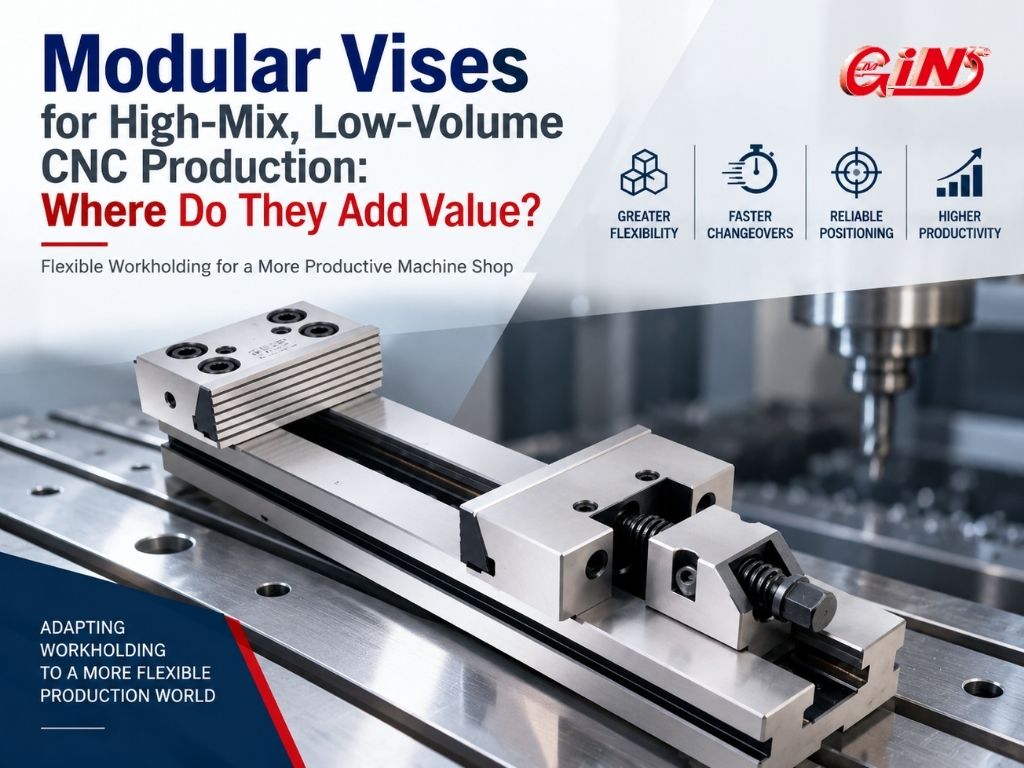
High-mix, low-volume manufacturing creates a different workholding challenge from repetitive mass production. Instead of running the same component for long periods, machine shops may need to switch frequently between different part sizes, geometries, materials, and batch quantities. In this environment, the time spent changing and adjusting workholding can become an important part of overall production efficiency.
This is where modular vises can provide practical value. Their configurable design allows manufacturers to adapt workholding arrangements to different workpieces without relying on a completely dedicated fixture for every job.
For CNC machine shops handling frequent production changes, the real benefit of a modular vise is not simply how tightly it holds a part. It is how effectively the workholding system supports setup flexibility, repeatable positioning, and faster changeovers.
Table of Contents
- What Is High-Mix, Low-Volume CNC Production?
- Why Workholding Becomes a Challenge in High-Mix Production
- 1. Modular Vises Provide Greater Setup Flexibility
- 2. Reducing Changeover Time Between Different Jobs
- 3. Supporting Different Workpiece Sizes with One Workholding Concept
- 4. Maintaining Repeatable Positioning After Setup Changes
- 5. Reducing Dependence on Dedicated Fixtures
- 6. Improving Machine Utilization in High-Mix Production
- Modular Vise vs. Dedicated Fixture for HMLV Production
- When Does a Modular Vise Add the Most Value?
- Gin Tech Precision Modular Vise for Flexible CNC Workholding
- FAQ: Modular Vises for High-Mix, Low-Volume Production
- Related Articles
- Conclusion
What Is High-Mix, Low-Volume CNC Production?
High-mix, low-volume (HMLV) production refers to manufacturing environments where many different part types are produced in relatively small quantities. A shop may machine one component today and switch to a completely different workpiece for the next order.
This production model is common in:
- Custom machining
- Mold and die manufacturing
- Prototype production
- Machinery components
- Replacement and spare parts
- Small-batch precision components
- Contract CNC machining
Unlike high-volume production, where dedicated fixtures can remain on a machine for long periods, HMLV manufacturing requires frequent setup changes.
As a result, workholding needs to provide more than rigidity. It must also offer enough flexibility to accommodate changing workpiece requirements without making every new job a time-consuming fixture project.
Why Workholding Becomes a Challenge in High-Mix Production
When the workpiece changes frequently, the vise or fixture may need to change with it. Different parts can require different jaw positions, clamping locations, support points, and machining access.
A conventional fixed workholding arrangement may work perfectly for one component but become inefficient when the next part has significantly different dimensions.
This can create several production challenges:
- Frequent vise and fixture adjustments
- Longer setup and changeover times
- Repeated workpiece alignment
- Additional dedicated fixtures
- More setup verification before machining
- Reduced machine utilization between jobs
For a large production run, spending additional time preparing a dedicated setup may be acceptable because that time is distributed across hundreds or thousands of parts.
For a batch of only a few components, however, setup time represents a much larger portion of the total production cycle. This is one reason modular vises become particularly relevant to high-mix, low-volume CNC production.
1. Modular Vises Provide Greater Setup Flexibility
The primary advantage of a modular vise is flexibility.
Instead of treating the vise as one fixed configuration, a modular workholding system allows the setup to be adapted according to the dimensions and requirements of the workpiece.
This can be particularly useful when a shop regularly processes components with different:
- Lengths
- Widths
- Clamping positions
- Machining requirements
- Batch quantities
The objective is not to eliminate setup work completely. Rather, modular workholding gives operators a more adaptable starting point when moving from one job to another.
For HMLV production, where tomorrow's workpiece may look very different from today's, this flexibility can reduce dependence on job-specific workholding arrangements.
2. Reducing Changeover Time Between Different Jobs
Machine time is valuable, but a CNC machine cannot produce parts while operators are rebuilding or realigning the workholding setup.
In high-mix production, even relatively short setup procedures can accumulate when they are repeated many times throughout the week.
A modular vise can help simplify changeovers by allowing operators to reconfigure the workholding arrangement rather than replace the entire setup for every new workpiece.
This can reduce time spent on tasks such as:
- Changing workholding devices
- Adjusting clamping positions
- Preparing new fixture arrangements
- Re-establishing the setup for different workpiece dimensions
The actual time savings depend on the part and production process, but the principle is straightforward: the easier the workholding system is to adapt, the less setup complexity is introduced when production changes.
For small batches, this can have a significant effect on overall machine utilization.
3. Supporting Different Workpiece Sizes with One Workholding Concept
A common challenge in job shops is the wide range of workpiece sizes moving through the same CNC machine.
Using a dedicated vise or fixture for every size can increase tooling inventory and complicate production planning. A precision modular vise provides a more adaptable approach by allowing the workholding configuration to be adjusted according to the part.
For example, one production schedule may include a short component followed by a longer workpiece requiring a different clamping span. Instead of treating these as completely separate workholding problems, an appropriate modular system may allow the operator to modify the configuration around the new part.
This makes modular vises particularly useful for manufacturers that cannot predict a single standardized workpiece size across future orders.
4. Maintaining Repeatable Positioning After Setup Changes
Flexibility is valuable only when it does not compromise machining accuracy.
Every time a workholding setup changes, the operator needs confidence that the workpiece can still be positioned securely and consistently. Poor referencing or unstable clamping can introduce dimensional variation and additional inspection work.
A precision modular vise should therefore combine configurability with:
- Accurate reference surfaces
- Stable clamping
- Rigid construction
- Consistent positioning
- Reliable component alignment
This balance between flexibility and precision is particularly important in HMLV manufacturing.
A system that is easy to adjust but difficult to position accurately simply transfers time from fixture setup to alignment and inspection. Effective modular workholding should make configuration changes practical while preserving the precision required by the machining process.
5. Reducing Dependence on Dedicated Fixtures
Dedicated fixtures can be highly effective when producing the same component repeatedly. They can be optimized around a specific geometry and production sequence.
The economics become different when only a small number of parts are required.
Designing, manufacturing, storing, and maintaining a dedicated fixture for every low-volume job may add unnecessary cost and lead time. For shops processing many different components, fixture inventory can also become increasingly difficult to manage.
A modular vise can provide an alternative for workpieces that do not justify dedicated fixturing.
Instead of creating a completely new workholding solution, manufacturers can adapt an existing modular platform to suitable jobs.
Dedicated fixtures will still be the right choice for certain components. The advantage of modular workholding is that not every new workpiece automatically requires a new dedicated fixture.
6. Improving Machine Utilization in High-Mix Production
The productivity of a CNC machine should not be evaluated only by cutting speed.
In HMLV production, manufacturers also need to consider the time between machining cycles. If a machine spends a significant amount of time waiting for fixture changes, workpiece alignment, or setup verification, actual utilization decreases.
This makes setup efficiency an important productivity factor.
A well-planned modular vise setup can help shorten the transition between different jobs and allow the machine to return to production sooner.
The benefit becomes increasingly relevant as the number of different jobs increases. Saving a modest amount of setup time on one changeover may appear insignificant, but repeating that improvement across many job changes can create a meaningful operational advantage.
Modular Vise vs. Dedicated Fixture for HMLV Production
Neither option is automatically better. The appropriate workholding strategy depends on production requirements.
| Factor | Modular Vise | Dedicated Fixture |
|---|---|---|
| Production Variety | Well suited to frequently changing parts | Best suited to specific parts |
| Batch Size | Particularly useful for low to medium quantities | Often justified by higher quantities |
| Setup Flexibility | High | Low |
| Initial Fixture Preparation | Generally lower | May require additional design and manufacturing |
| Repeat Production | Can be reconfigured as needed | Highly efficient for the intended component |
| Workpiece Geometry | Suitable when modular clamping can accommodate the part | Can be optimized for complex or specialized geometry |
| Fixture Inventory | Helps reduce the need for numerous dedicated setups | Separate fixtures may be required for different parts |
For high-mix, low-volume production, the decision should therefore focus on the total setup strategy, rather than simply comparing the purchase price of individual workholding devices.
When Does a Modular Vise Add the Most Value?
A modular vise becomes especially valuable when production changes frequently enough that fixed workholding begins to create unnecessary setup effort.
It may be worth considering when:
- Your CNC machines process many different workpiece sizes
- Production batches are relatively small
- Setup and changeover time is becoming significant
- Dedicated fixtures are difficult to justify for every job
- Workholding configurations need to change regularly
- Maintaining positioning accuracy after setup changes is important
On the other hand, a dedicated fixture may remain more appropriate when a single component is produced repeatedly in large quantities or when its geometry requires highly specialized support and clamping.
The key question is therefore not simply, "Is a modular vise better?"
A more useful question is:
"How often does our workholding need to change, and how much production time are those changes consuming?"
Gin Tech Precision Modular Vise for Flexible CNC Workholding
Gin Tech's Precision Modular Vise is designed for precision workholding applications where stable clamping and setup flexibility are important.
For manufacturers processing different workpiece sizes or frequently changing production requirements, the modular concept provides greater flexibility in arranging the workholding setup while maintaining the precision required for CNC machining.
Rather than using a single fixed workholding arrangement for every job, manufacturers can select a vise configuration according to their actual workpiece and machining requirements.
This makes Gin Tech's precision modular vise particularly relevant to high-mix, low-volume production, tool rooms, mold and die applications, and CNC job shops where production requirements can change from one order to the next.
When evaluating a modular vise, however, the workpiece dimensions, clamping position, machining direction, required accuracy, and machine configuration should always be considered together. The best workholding solution is the one that provides sufficient flexibility without sacrificing rigidity or machining accessibility.
FAQ: Modular Vises for High-Mix, Low-Volume Production
Can a modular vise completely replace dedicated fixtures?
Not in every application. Modular vises are useful when different workpieces can be accommodated through configurable workholding, but complex components, high-volume production, or specialized machining operations may still benefit from dedicated fixtures.
When does reducing setup time matter most?
Setup time becomes particularly important when batches are small and jobs change frequently. In these situations, setup represents a larger percentage of total production time, so improving changeover efficiency can have a greater impact on machine utilization.
What should be evaluated before selecting a modular vise?
Consider the workpiece size and geometry, required clamping range, machining access, positioning accuracy, clamping stability, machine configuration, and how frequently the production setup needs to change.
Related Articles
- How Modular Vises Improve Flexibility in Multi-Setup Machining – Learn how modular vises can reduce setup time, improve workholding flexibility, and support changing machining requirements in multi-setup production.
- 5 Ways High-Precision Machining Vises Improve CNC Efficiency and Accuracy – Explore how high-precision machining vises improve clamping stability, repeatability, setup efficiency, and overall CNC productivity.
- Milling Vise vs. Self-Centering Vise: Which Is Better for Multi-Part Production? – Compare two common CNC workholding solutions and understand how setup time, repeatability, and production style affect vise selection.
Conclusion
In high-mix, low-volume CNC production, workholding flexibility can be just as important as clamping performance. Frequent changes in workpiece size, geometry, and batch quantity make it difficult to rely on a single fixed setup or justify a dedicated fixture for every job.
Modular vises provide an adaptable workholding approach that can help manufacturers simplify setup changes, accommodate different workpieces, maintain reliable positioning, and reduce unnecessary fixture preparation.
Their greatest value is not simply that they can be reconfigured. It is that they can help make frequent production changes easier to manage without losing sight of the accuracy and stability required for CNC machining.
Gin Tech provides precision modular vise solutions for manufacturers looking to improve workholding flexibility across changing production requirements.
If your CNC operation involves frequent job changes, different workpiece sizes, or small production batches, contact Gin Tech to discuss your application. Our team can help you evaluate a suitable modular vise and workholding configuration based on your workpiece, machining process, and production requirements.